Know the conference landscape
Cybersecurity Conference Types
From academic research and flagship hacker conferences to community events and industry forums, understand the seven badges in our cybersecurity conference catalog.
By Awesome Cybersecurity Conferences
Published · Updated
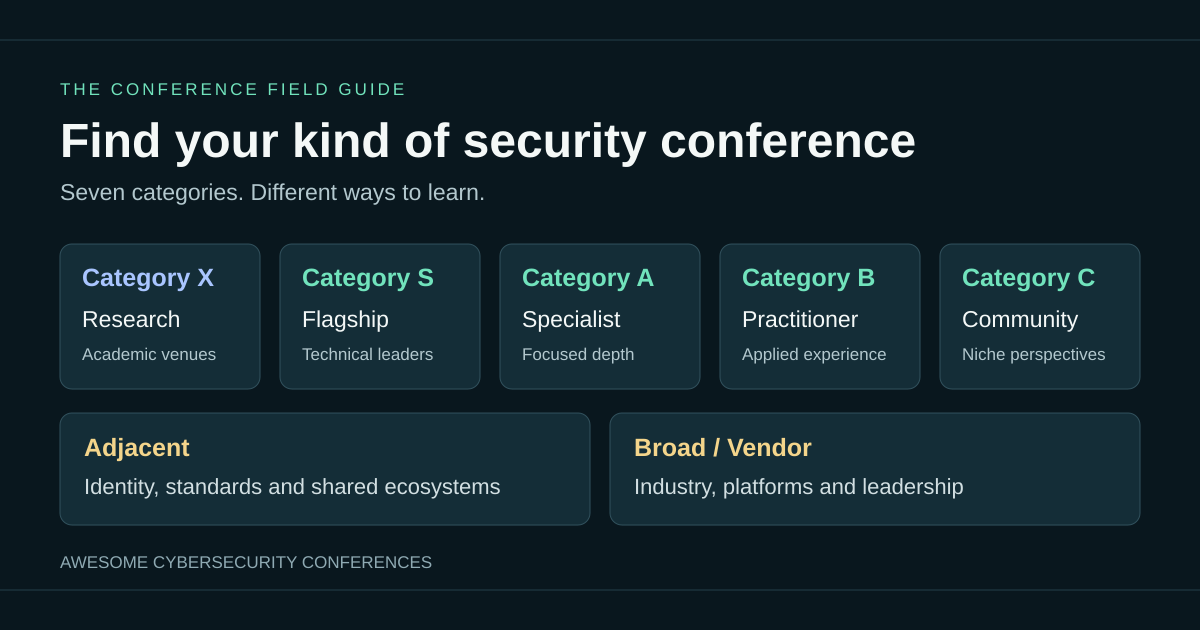
Cybersecurity conferences serve different purposes. Some introduce research through peer-reviewed papers. Others bring practitioners together to share an exploit, explain an incident, compare defensive approaches or build a local community. Industry events add another perspective: the platforms, policies and business decisions that shape security work.
Our catalog brings those formats together. Each conference series belongs to one of seven categories to help you decide where to explore: X, S, A, B, C, Adjacent or Broad / Vendor. These categories serve different audiences and learning goals. They do not rank conferences or imply that one category is better than another. This guide explains what the categories mean and how to use them when choosing recordings to watch.
Conference classification methodology
Our conference classification methodology groups conferences by audience, purpose and technical focus. These are discovery categories, not an industry certification or a score for every speaker. A specialist talk at a small event may be exactly what you need; a well-known flagship may cover a subject outside your interests.
X identifies formal research venues. S, A, B and C distinguish flagship, specialist, practitioner and community-oriented cybersecurity events. Adjacent and Broad / Vendor describe a different center of gravity. Read the badge alongside the programme and the individual talk, and choose according to your question rather than the letter alone.
Category X
Category X: academic and research-first venues
Category X covers formal academic security and related research venues, including academic AI venues. Their programmes are selected through academic review and published as archival proceedings. Expect research questions, methods, evaluations and discussion of what a result does—and does not—establish.
X is not a step above S. It marks a different kind of event. Having a research track or an academic keynote does not by itself place a conference in Category X. USENIX Security and NDSS Symposium are examples in this category. Start here when you want to investigate a result in depth and follow its underlying paper.
Category S
Category S: flagship technical conferences
Category S identifies established cybersecurity flagships with globally recognized technical value and a sustained reputation for substantial content. These are useful places to explore advanced security work across several domains, from offensive research to defensive engineering.
The DEF CON main conference and Black Hat USA Briefings are examples. A flagship badge describes the recurring conference series; it does not promise that every session is advanced, or assign the same label to every training course, village or panel associated with the brand.
Category A
Category A: respected technical specialists
Category A covers highly regarded technical events with strong specialist programmes. Their value often comes from depth in a particular area: malware analysis, reverse engineering, exploit research, cloud security, application security, hardware, industrial systems or incident response.
HITBSecConf and Botconf are examples in the catalog. Explore this category when you have a specific technical interest and want detailed approaches, research or engineering lessons from people working in that field. Specialist does not necessarily mean small, and a broader audience does not prevent a programme from being technically demanding.
Category B
Category B: strong practitioner conferences
Category B covers established practitioner, regional, community and specialist conferences with useful technical cybersecurity content. These events offer practical perspectives: how people investigate problems, apply techniques and learn from work in real environments.
The general BSides group and NorthSec are examples. Category B is a useful starting point for exploring applied security and regional communities. It is not a beginner-only label: an individual session can still assume substantial experience or examine a difficult technical problem.
Category C
Category C: community, niche and emerging events
Category C helps surface community-centered, niche, emerging or mixed-scope cybersecurity events. They can offer specialist interests, local experience and perspectives that are easy to miss when you browse only the largest conference brands.
PancakesCon and The Diana Initiative are examples in this category. A C badge is not a verdict that an event or its speakers are unimportant. It places the series in a discovery category; the usefulness of a particular talk still depends on its subject, evidence and relevance to you.
Adjacent
Adjacent: the ecosystems security depends on
Some events matter to security without being primarily technical cybersecurity conferences. Adjacent covers relevant work in identity, standards, privacy, open source and developer ecosystems. These programmes help explain the systems and conventions that security teams need to understand.
Keycloak DevDay and OpenSSL Conference are catalog examples. Explore this category when your question is tied to a particular identity system, cryptographic ecosystem or shared standard. The label describes the event's focus; it does not mean its security implications are minor.
Broad / Vendor
Broad / Vendor: industry, platforms and leadership
Broad / Vendor covers industry, vendor, executive, policy and strategy-focused events. Security may be a major subject, but the overall programme has a wider remit than technical cybersecurity research or practice. AWS re:Invent and the broad RSA Conference offering are examples.
This category can help you understand platform direction, leadership priorities and the wider context for security decisions. It can also contain detailed technical sessions. Vendor involvement alone does not determine the badge: a security-research-focused event can sit in a technical category. Look at the specific programme and recording, not just who sponsors it.
A series badge is not a rating for every track
A conference family is an umbrella brand. A series is a recurring event, an edition is one occurrence, and an individual track or village has its own scope. Those distinctions matter: a technical main conference, a policy village and a training playlist can serve very different audiences even when they share a brand.
We use family defaults with specific named exceptions. Black Hat is in Category A by default, while Black Hat USA is in Category S. BSides is in Category B by default, while BSides Las Vegas and BSides San Francisco are in Category A. Those exceptions do not automatically change other regional events or chapters. A new annual edition also does not create a new classification group.
Series classification and recording-set assessment are separate. A playlist's completeness or video count does not automatically change the series badge. Archive is an internal catalog state, not an eighth public category; archived rows are excluded from the normal public series listing.
Use the badge to start exploring
Begin with the question you want to answer. For a formal research result, explore X. For flagship technical programmes, explore S. For depth in a domain, explore A. For applied practitioner experience, explore B. For community and niche perspectives, explore C. Use Adjacent for the surrounding systems and standards, and Broad / Vendor for industry and leadership context.
Then look beyond the badge. Browse a subject, open a conference edition and choose a recording whose focus matches your interests. The catalog includes English and non-English recordings, so language is another useful part of discovery. A badge helps you find a starting point; the talk itself is where the learning happens.